
Most drugs are metabolized by Cytochrome P450 enzymes, which are primarily found in the liver. These cytochromes, along with about thirty other enzymes, carry out biotransformations known as phase I reactions. Additionally, around twenty other enzymes are responsible for phase II reactions, which generally involve conjugation processes. While cytochromes are involved in most metabolic processes, there is growing interest in understanding the mechanisms of non-CYP metabolic reactions.
In MetaSite 7, there are 23 non-CYP phase I enzymes considered. Besides FMO3 and AOX1, which were already present in MetaSite 6, the list has been expanded to include eight families and their related isoforms. Furthermore, enzymes responsible for the main phase II conjugation reactions have also been added, covering 11 different families and 19 enzymes in total.
In addition to these new enzymes, the computational method used in MetaSite 7 is innovative. Predictions are based not only on the ligand’s reactivity-structure relationship but also heavily on a three-dimensional component. This component relies on the 3D structure of the enzyme and the ligand’s ability to interact with it, exposing the reactive group and facilitating the reaction mechanism.
MetaSite command-line execution is controlled through script files written in a simple declarative language, allowing for sequential command execution. This language provides flexibility similar to the graphical interface, enabling operations such as opening, saving, and manipulating MetaSite document files. Users can alternate between command-line and GUI execution, such as importing objects and performing calculations via the command line, then browsing results in the GUI. In MetaSite7, these options are expanded to include all non-CYP Phase I enzymes, Phase II enzymes, or a combined CYP -Phase I – Phase II process.
2024: Decoding phase I & II human drug metabolism using the prediction tool MetaSite for chemists, medicinal chemists, and metID experts.
Gabriele Cruciani, Jenny Desantis, Tommaso Palomba, Massimo Baroni, Aurora Valeri, Lydia Siragusa, Ludovico Venturi, Ismael Zamora, Christophe Meyer, Laurent Laboureur, Isin Emre, and Laura Goracci
Articles:
- Structure-metabolism relationships in human- AOX: Chemical insights from a large database of aza-aromatic and amide compounds
- April 2018.Lepri S, Ceccarelli M, Milani N, Tortorella S, Cucco A, Valeri A, Goracci L, Brink A, Cruciani G
- From Experiments to a Fast Easy-to-Use Computational Methodology to Predict Human Aldehyde Oxidase Selectivity and Metabolic Reactions
- January 2018. Cruciani G, Milani N, Benedetti P, Lepri S, Cesarini L, Baroni M, Spyrakis F, Tortorella S, Mosconi E, Goracci L
- Software-aided cytochrome P450 reaction phenotyping and kinetic analysis in early drug discovery
- January 2016. Cece-Esencan EN; Fontaine F; Plasencia G; Teppner M; Brink A; Pähler A; Zamora I
- Flavin monooxygenase metabolism: why medicinal chemists should matter
- December 2014. Cruciani G, Valeri A, Goracci L, Pellegrino RM, Buonerba F, Baroni M
- Exposition and reactivity optimization to predict sites of metabolism in chemicals
- Spring 2013. Cruciani G, Baroni M, Benedetti P, Goracci L, Fortuna CG
- CYP2C9 Structure−Metabolism Relationships: Optimizing the Metabolic Stability of COX-2 Inhibitors
- August 2007. Ahlström MM, Ridderström M, Zamora I, Luthman K. J
- Comparison of methods for the prediction of the Metabolic sites for CYP3A4 – Mediated metabolic reactions
- June 2006. , , , , and
- MetaSite: Understanding Metabolism in Human Cytochromes from the Perspective of the Chemist
- September 2005. Cruciani G, Carosati E, De Boeck B, Ethirajulu K, Mackie C, Howe T, Vianello R
- Predicting drug metabolism: a site of metabolism prediction tool applied to the cytochrome P450 2C9
- June 2003. Zamora, Ismael; Afzelius, Lovisa; Cruciani, Gabriele
What are the key new features in MetaSite7 compared to earlier versions?
- MetaSite7 significantly expands Site of Metabolism (SoM) prediction capabilities. In addition to Cytochrome P450 (CYP) and key non-CYP Phase I enzymes (such as FMO3 and AOX1), version 7 introduces 21 other non-CYP Phase I enzymes (across 8 families) and 19 Phase II enzymes (covering 11 families, including UGT glucuronidation, SULT sulfation, GST, etc.).
- The computational core combines structural reactivity with an innovative 3D enzyme-ligand recognition model tailored to each enzyme evaluated.
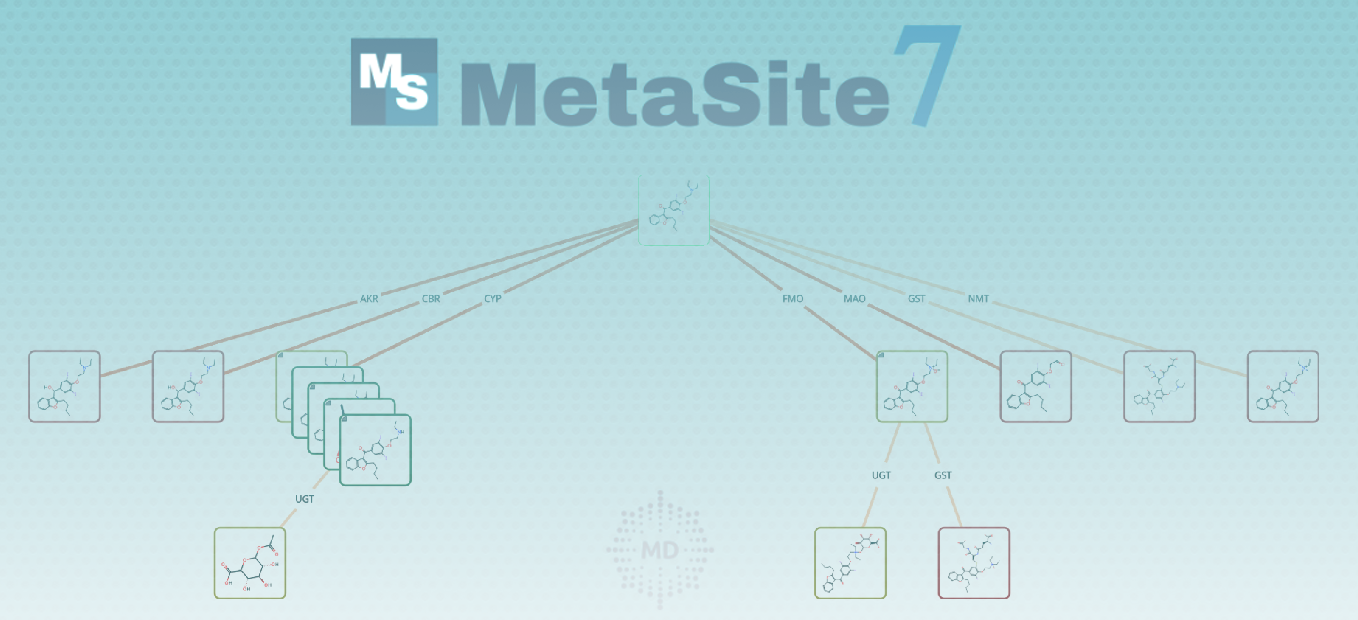
- Combined Phase I & Phase II Modality: Predicts the potential entire metabolic pathway of a parent molecule by combining Phase I and Phase II enzymes. This multi-step biotransformation model can predict metabolites up to the 4th generation.
- Isoform Selectivity Analysis: Estimates the likelihood of a molecule being metabolized by different CYP isoforms. Each processed molecule is classified as having a LOW, MEDIUM, or HIGH probability of being a substrate based on predicted probability scores.
- The REVENG Function: Offers a groundbreaking solution to predict potential enzymatic pathways responsible for metabolite formation. Users can input the chemical structure of an experimentally identified metabolite alongside the parent molecule, and the software’s advanced algorithms predict potential multi-step pathways leading to that metabolite. Furthermore, REVENG ranks these pathways by assigning probability levels to each biotransformation step and estimates the involvement of the responsible enzymes.
Which molecular file formats are supported for import?
MetaSite supports standard cheminformatics formats, including:
- SDF / MOL (single or multi-molecule 2D/3D structure files)
- MOL2 (single or multi-molecule)
- Single SMILES or SMILES list (structure strings)
Can MetaSite7 be automated via command-line or batch scripts?
Yes. MetaSite7 supports execution via a Command Line Interface (CLI) controlled by declarative script files. This enables batch processing of large compound libraries and seamless switching between CLI execution and the GUI (e.g., importing/processing via CLI and inspecting/exporting results in the GUI).
Can MetaSite7 be run on a MacBook or inside a Virtual Machine?
We do not support running MetaSite7 on macOS/MacBook. Similarly, we do not recommend using virtual machines, as VM configurations and virtualized hardware architectures can negatively impact software performance and stability. Full technical support is guaranteed only for native Windows and Linux (such as CentOS, Ubuntu and Rocky Linux) installations.
Does MetaSite7 support the use of deuterated molecules?
Yes, MetaSite7 fully supports deuterated molecules. You can import them using:
- SMILES strings: Using either standard isotope notation, such as [D] or [2H] (e.g., [2H]C or [D]C).
- SDF / MOL files: As long as the deuterium isotope tag is correctly defined within the atom block of the file structure.
Can MetaSite7 predict reactive metabolites?
MetaSite7 does not feature a direct module specifically for predicting chemical reactivity. However, predicted metabolites can be used—either manually or automatically in a combined workflow—as substrates for subsequent biotransformation steps to assess potential Sites of Metabolism (SoM) and downstream products.
- Example: Glutathione (GSH) conjugation often occurs on reactive intermediates generated during earlier biotransformation steps. By running a combined multi-step prediction (Phase I + Phase II), you can trace the full GSH conjugation pathway, thereby identifying the transient, reactive intermediate metabolites involved in the process.
Can I export predicted metabolites and calculation results from MetaSite7?
Yes, MetaSite7 offers multiple export options depending on the data type:
- Metabolites: Can be exported as SDF or CSV files.
- Sites of Metabolism (SoM): Can be exported as SDF files.
- REVENG Predictions: Can be exported as CSV files.
- Visualizations: All heatmaps and metabolic pathways shown in the interface can be exported as images (PNG).
Does MetaSite7 support the prediction of Glutathione (GSH) conjugation?
Yes. MetaSite7 includes a dedicated prediction model for GSH conjugation. The model combines 3D docking approaches with algorithms designed to identify electrophilic centers within the molecule, allowing the software to accurately rank potential Sites of Metabolism (SoM) for glutathione trapping and conjugation.
How does the Combined Prediction workflow work in MetaSite7?
Starting from the parent molecule of interest, users can execute the prediction in two ways:
- “OneClick” Mode: Uses optimized default parameters to launch the calculation immediately.
- Custom Mode: Allows full customization of settings, including the number of prediction iterations (steps), the specific enzymes used per step, and metabolite generation criteria.
The Step-by-Step Algorithm:
- First Iteration (Parent Level): The algorithm executes Phase I and Phase II predictions directly on the initial parent substrate. It calculates the Substrate Probability, predicts the Sites of Metabolism (SoM), and generates the resulting primary metabolites.
- Subsequent Iterations (Promoted Substrates): Phase I metabolites generated in the previous step are “promoted” to act as new substrates for the next round of prediction using selected Phase I and Phase II enzymes (based on your filtering criteria).
- Iterative Pathway Generation: This promotion and prediction loop repeats according to the selected number of iterations, progressively building multi-generational biotransformation pathways (up to 4th generation metabolites).
What does the "Metabolites to consider" setting mean in the MetID options of Combined Prediction?
The “Metabolites to consider” setting determines how many Phase I metabolites from each iteration cycle are automatically promoted to act as substrates for the next prediction step. The value applies individually to each Phase I enzyme used in that iteration. By selecting “Best 1 Score”, promotes the top-scoring Phase I metabolite for each enzyme (or multiple metabolites in the event of a tie for first place) to serve as substrates in the subsequent iteration.